
Fans Thought Marcellus Was Acting. Now They Can’t Unsee the Moment That Feels Too Real.
Marcellus was supposed to be the quiet emotional anchor of Remarkably Bright Creatures.
A giant Pacific octopus in a glass tank. A strange, almost impossible narrator watching human grief unfold. A creature who never speaks aloud, yet somehow seems to understand everything about loss, memory, and the fragile way families fall apart and find each other again.
But now, a single moment in the final act is tearing through social media, with viewers insisting something in the scene feels “wrong” in the most emotional way possible.
Not wrong in a technical sense.
Wrong in a human sense.
And if fans are right, then one of Netflix’s most delicate endings may have accidentally captured something that was never meant to feel this alive.

The moment in question arrives near the end of the film, after Tova Sullivan stands just outside Marcellus’ tank, finally close enough to confront everything she has been avoiding for years.
By this point, the story has already done its work. The mystery of her son Erik has begun to unravel. Cameron’s presence in Sowell Bay has shifted from coincidence to something far more emotionally loaded. And Marcellus—silent, watchful, patient—has become something between witness and guide.
But then comes the shot that fans keep replaying.
Tova steps closer to the glass.
The room is quiet enough that even the aquarium feels suspended in time.
And Marcellus moves.
Not dramatically. Not theatrically. Not in any way that screams “story beat.”
Just a subtle shift forward, as if pulled by something unseen.
One eye remains locked on her.
A tentacle presses lightly against the glass.
It lasts less than a second longer than expected.
But that second is everything.
“That Wasn’t Just Blocking,” Fans Are Insisting
Some viewers claim the reaction feels too perfectly timed to be purely scripted. Others insist it looks like something the editing team might not have fully anticipated when assembling the final cut.
The argument is not that the scene was “real” in a literal sense.
It’s that it feels responsive.
As if Marcellus is not just performing a role in a story, but reacting to the emotional weight in front of him.
One viral post summed it up bluntly:
“I know it’s a movie, but that octopus moved like he understood what she was going through.”
That is the part people cannot shake.
Because Remarkably Bright Creatures already asks viewers to believe something unusual—that Marcellus is not just intelligent, but emotionally perceptive in a way that borders on impossible.

This moment makes that belief feel uncomfortably tangible.
Why the Moment Feels So Unnaturally Human
What makes the scene so haunting is not spectacle.
It is restraint.
There is no dialogue exchange designed to explain emotion. No dramatic music swell guiding the audience toward a reaction. No external cue telling viewers how to feel.
Just stillness.
Tova’s face carries decades of grief, not in an exaggerated way, but in the quiet exhaustion of someone who has learned to live beside pain instead of surviving it.
Sally Field plays it with a kind of emotional minimalism that makes the slightest movement feel seismic.
And then Marcellus answers it.
That contrast—human stillness versus animal motion—creates the illusion of communication without words.
It feels less like a scripted moment and more like recognition passing between two beings who understand something the rest of the world cannot see.
Marcellus Was Never Just Background Intelligence
Part of why this theory has exploded is because Marcellus was never treated like a typical animal character.
He is not comic relief.
He is not decoration.
He is not there to fill space between human scenes.
He is positioned as a presence that observes everything but belongs fully to nothing.
From the beginning, he appears to understand emotional patterns before the humans do. He recognizes connections that are still forming. He seems aware of grief in a way that feels almost invasive in its clarity.
So when he moves in that final scene, it does not feel like random animal behavior.
It feels like acknowledgment.
Like he is not just seeing Tova.
He is registering her.
And that distinction is what unsettles viewers the most.
The Behind-the-Scenes Rumor That Keeps Growing
The most persistent theory online suggests that the timing of Marcellus’ movement may not have been entirely predictable.
According to fan speculation, the shot was originally intended as a simple static emotional beat: Tova at the glass, Marcellus still, camera holding the silence.
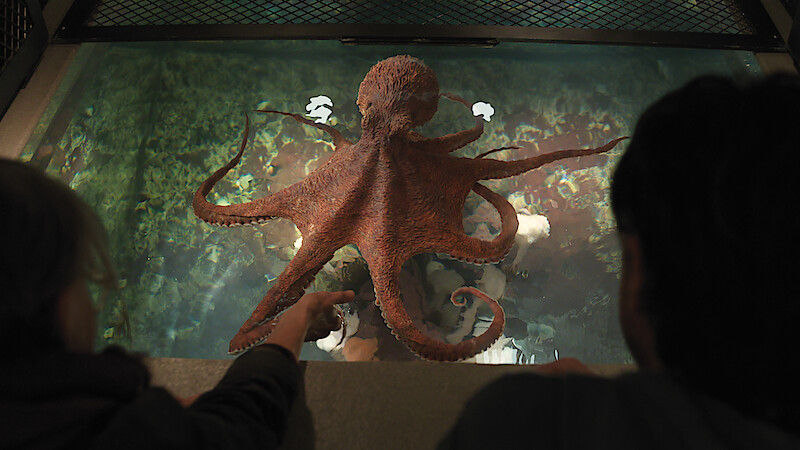
But in the final cut, something slightly different appears.
A shift.
A reaction that aligns almost too precisely with Tova’s emotional collapse in the scene.
Some fans believe the filmmakers saw something unexpected during filming or playback and decided to keep it because it deepened the emotional impact.
There is no official confirmation of this.
But the internet does not seem to need it.
The scene already carries the weight of possibility.
And that is enough.
The Detail That Changes the Entire Ending
Before this moment gained traction, the ending of Remarkably Bright Creatures was already understood as bittersweet closure.
Tova begins to piece together the truth about her family. Cameron’s identity shifts from mystery to revelation. And Marcellus, in his quiet way, helps bridge the emotional distance between them.
But with this new interpretation, the final tank scene takes on an additional layer.
It is no longer just about resolution.
It becomes about presence.
If Marcellus truly reacts in that moment, even subtly, then the ending is not just about human reconnection.
It is about witnessing.
About being seen at the exact moment when being seen matters most.
That is why fans keep asking the same question:
Was that goodbye?
Why the Internet Cannot Stop Rewatching It
Part of the fascination comes from how small the moment is.
There is no dramatic reveal hidden in the background. No shock twist waiting to be discovered on a freeze-frame.
Just a fraction of movement that feels emotionally disproportionate to its scale.
And that imbalance is exactly what makes it unforgettable.
Because grief, in the world of the film, is not loud.
It is slow.
It is internal.
It builds in silence until something small finally breaks through.
That is what Marcellus’ movement resembles. Not action, but response.
Not performance, but recognition.
And whether or not that interpretation is technically accurate, it has already reshaped how audiences experience the scene.
Final Take: A Moment That Feels Too Alive to Ignore
At its core, Remarkably Bright Creatures is already a story about unseen connections—between strangers, between generations, between grief and healing.
But this fan theory has added something unexpected to its legacy.
A belief that one small moment may have captured more emotional truth than intended.
Maybe it was carefully planned.
Maybe it was a coincidence of timing, editing, and performance aligning perfectly.
Or maybe it was something simpler.
A scene so quiet that even the smallest movement felt like meaning.
Whatever the explanation, viewers keep returning to it for the same reason.
Because for a brief second, Marcellus does not feel like a character performing in a story.
He feels like a presence responding to one.
And once you see it that way, it is very hard to see anything else.


