
Mamdani in SHOCK as Tax Hikes BACKFIRE!!!
New York’s Socialist Tax War Is Backfiring Spectacularly As Billionaires Flee, Wall Street Shrinks, And Miami Quietly Steals America’s Financial Crown
https://www.youtube.com/watch?v=1fhR4BvW5_s

New York City thought it could declare war on the rich without consequences.
That fantasy may now be collapsing in real time.
What began as a flashy progressive tax campaign targeting billionaires and luxury property owners is rapidly turning into one of the most humiliating financial backfires modern urban politics has seen in years.
And the people leaving are not exactly minor players.
We are talking about hedge-fund empires, banking giants, billionaire investors, and thousands of high-paying jobs quietly slipping away from Manhattan while Florida and Texas roll out the red carpet.
“Apparently, telling billionaires they’re villains works slightly worse when they control the tax revenue keeping your city alive.”
The political firestorm exploded after New York Mayor Zohran Mamdani released a dramatic tax-day video announcing a new “pied-à-terre” tax targeting ultra-luxury properties owned by wealthy individuals who do not live full-time in the city.
Standing on a Manhattan sidewalk with cameras rolling behind him, Mamdani framed the tax as a moral correction against rich outsiders allegedly using New York real estate as storage lockers for wealth.
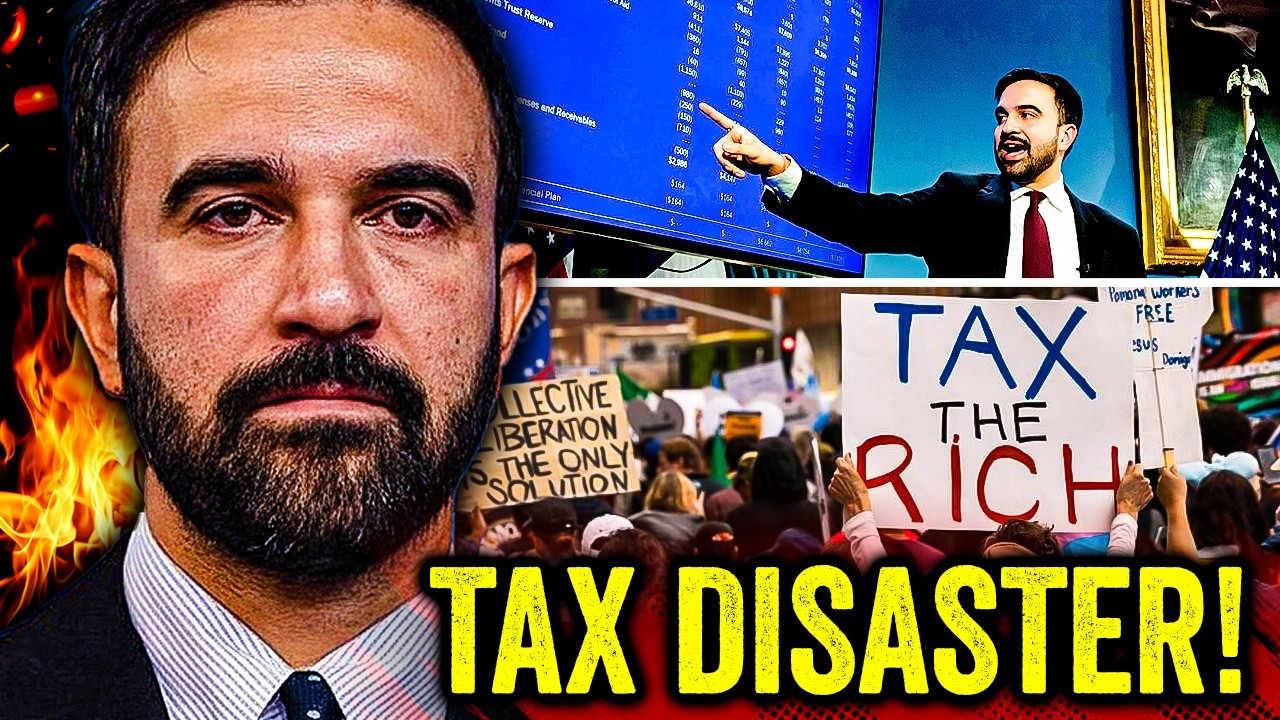
The proposal targeted luxury properties worth over $5 million.
Mamdani celebrated the plan openly.
He described it as a victory for working-class New Yorkers.
He promised the new revenue would help fund childcare, cleaner streets, and safer neighborhoods.
The applause came quickly.
So did the backlash.
Because one of the people indirectly targeted by the speech was Citadel CEO Ken Griffin, one of the most powerful hedge-fund managers in the world.
Griffin owns a $238 million penthouse in Manhattan.
But instead of publicly fighting back, Citadel reportedly made a far more devastating decision.
It simply reconsidered New York entirely.
According to reports described in the source material, Citadel executives circulated internal communications blasting Mamdani’s rhetoric as hostile and economically reckless.
Then came the bombshell.
Citadel’s enormous planned skyscraper project at 350 Park Avenue reportedly froze under internal review while the company accelerated expansion plans in Miami.
That was not just symbolic.
That was potentially billions of dollars in investment momentum suddenly shifting south.
And Ken Griffin did not exactly hide his frustration.
In comments referenced in the report, Griffin praised Florida’s embrace of business, personal liberty, education, and economic opportunity while drawing an increasingly brutal contrast between red-state growth and blue-state decline.
Translation.
Miami wants us.
New York wants our money but apparently hates us personally.
That distinction matters more than politicians sometimes realize.
Because businesses rarely leave only because of taxes.
They leave because they sense hostility.
They leave because they stop believing leadership sees them as partners instead of targets.
And once that perception settles in, every tax increase feels personal.
The terrifying part for New York is that Citadel may only be the beginning.
JPMorgan Chase CEO Jamie Dimon reportedly admitted in his shareholder letter that the bank’s New York workforce has shrunk dramatically over the last decade while Texas operations expanded aggressively.
The numbers are staggering.
New York headcount reportedly dropped from 30,000 employees to around 24,000.
Meanwhile, Texas reportedly grew from 26,000 employees to 32,000.
That is effectively a 6,000-job migration away from New York toward the South.
And this was not some partisan speech at a political rally.
This came inside a shareholder letter discussing raw business realities.
Dimon bluntly warned that New York is not automatically entitled to remain America’s financial capital forever.
That sentence should have sent shockwaves through every office tower in Manhattan.
Because when the CEO of America’s biggest bank openly questions New York’s long-term dominance, the warning is no longer theoretical.
It becomes a flashing red alarm.
The deeper economic math behind the crisis is even uglier.
According to the discussion referenced in the source material, less than 1% of New York City tax filers reportedly contribute roughly 37% of the city’s entire income-tax revenue.
Read that again slowly.
A tiny fraction of ultra-high earners is effectively carrying more than a third of the city’s tax system.
That is not diversification.
That is dependency disguised as economic strength.
And dependency becomes dangerous when the people paying the bills realize they can move.
“Nothing says stable economic planning quite like building your budget on a handful of billionaires who already own homes in Florida.”
The city’s fiscal problems make the situation even more explosive.
New York reportedly faces a multi-billion-dollar budget gap already projected to grow dramatically over the next few years.
Meanwhile, the celebrated luxury-property tax promoted by Mamdani is expected to generate only around $500 million annually according to estimates discussed in the report.
That may sound impressive politically.
Financially, it barely dents the scale of the problem.
Critics immediately pointed out the uncomfortable irony.
Citadel alone reportedly contributes billions in taxes across city and state systems.
One major financial player may already contribute several times more revenue than the entire symbolic “tax the rich” initiative.
That is where the progressive political narrative starts colliding violently with arithmetic.
Because ideology can win applause.
But arithmetic eventually sends invoices.
And the market does not negotiate emotionally.
The migration trend now spreading across New York is part of a much larger national transformation.
Florida is aggressively recruiting financial firms.
Texas is expanding as a banking and investment hub.
Tennessee continues attracting corporations with lower taxes and pro-business policies.
Wealthy individuals increasingly relocate not just because of taxes, but because entire ecosystems are forming around those moves.
Executives relocate.
Then firms expand nearby.
Then suppliers follow.
Then jobs move.
Then investment shifts.
Then tax bases weaken back in the original city.
This is how financial capitals decline.
Not through one dramatic collapse.
Through thousands of individual decisions that slowly add up into a different map of power.
And New York’s political class may still underestimate how serious the threat has become.
The city built its modern identity around the assumption that nobody would ever willingly leave Manhattan’s financial orbit.
That assumption worked for decades.
Wall Street was Wall Street.
New York was New York.
But remote work, digital finance, tax competition, and changing political climates have shattered the illusion that geography alone guarantees dominance.
Miami now openly markets itself as the future home of finance.
Texas positions itself as the operational center for banking expansion.
And increasingly, executives are agreeing.
The psychological effect of Mamdani’s rhetoric may prove even more damaging than the actual taxes.
Critics argue his messaging framed wealth creation itself as morally suspicious.
That approach may energize progressive activists.
But it also signals to investors that success could eventually make them political targets.
That fear spreads quickly in financial circles.
Because today’s billionaire tax can become tomorrow’s millionaire tax.
And eventually, upper-middle-class professionals start wondering when they become next.
That fear was openly discussed during televised political debates referenced in the report.
Some commentators warned that once governments normalize punitive rhetoric against top earners, the tax net inevitably expands downward.
Whether one agrees with that argument or not, perception alone can drive behavior.
And behavior is already changing.
Wells Fargo reportedly expanded major operations in Florida.
Apollo Global Management has explored southern expansion.
Citadel doubled down on Miami.
JPMorgan shifted workforce growth toward Texas.
Meanwhile, New York continues debating how to tax the shrinking pool of remaining high earners even harder.
That strategy may work politically for a while.
Economically, it risks becoming a death spiral.
Because once enough wealthy residents and firms leave, the city faces an impossible choice.
Cut spending dramatically.
Or raise taxes even further on whoever remains.
That is where urban decline accelerates.
The irony buried inside the entire controversy is painful.
New York became one of the richest cities on earth precisely because generations of entrepreneurs, financiers, immigrants, and risk-takers believed success would be rewarded there.
Now critics argue the city increasingly treats success itself like a public enemy.
And whether that perception is entirely fair almost no longer matters.
Because markets react to perception long before politicians finish debating fairness.
The warning signs are already visible.
Empty office towers.
Shrinking financial headcounts.
Corporate relocations.
Slower investment growth.
Rising budget pressure.
And a growing realization that America’s financial geography is changing faster than New York’s political leadership appears prepared to admit.
Mamdani’s supporters insist the wealthy should contribute more to fix inequality and fund public services.
Opponents counter that you cannot endlessly punish the people funding your system without eventually breaking the system itself.
Both sides believe they are defending fairness.
But only one side controls where the capital flows next.
That is the brutal reality now haunting New York City.
The billionaires did not scream.
They did not riot.
They did not beg politicians to reconsider.
They simply updated addresses, moved employees, shifted projects, and redirected investment toward states that made them feel wanted instead of hunted.
And that quiet migration may prove more devastating than any public political fight ever could.
Because by the time empty towers and shrinking tax revenue fully expose the damage, the money may already be gone.


